Tuesday, May 25, 2010

Last Field Trip of the Year

Today was our last day of school for the year, and yesterday we went on our last field trip for the year. We went to Fort Indiantown Gap and toured the historical sites and monuments as well as the National Cemetery. We saw some really cool things, learned some great Pennsylvania history and really enjoyed the day. The morning was quite overcast and so we began our tour with the Pennsylvania National Guard Military Museum, and by the time we finished there and took a lunch break, the sun was shining.


This was probably our favorite of the monuments. Below you can read about the symbolism that is exhibited in this monument. It has tremendous meaning. I hope you can read it or maybe it will enlarge if you click on it so you can read it.


In this photo, you can see, through one of the holes in the monument, some of the dog tags hanging on a chain in the middle of the monument. (Yes, for those of you who read my Cozy Comforts blog, this is the photo that I was so determined to capture).


We saw some wonderful things in the museum. In this photo is the medal of valor. The man at the museum said that not many people get to see one of these in person, so being able to see this one at the museum was really special.


This is an old telephone switchboard. It reminded me of "The Waltons".


A. (Anthony) J. Drexler Biddle is a very prominent military figure. He moved all the way to the rank of "Adjutant General", and he won many important awards and medals. In the bottom section of this photo, on the left, he is shaking hands with Dwight D. Eisenhower, and in the photo on the right, he is sitting beside a portrait that Dwight D. Eisenhower painted of him. We were hoping to purchase a book about General Biddle to learn more but the man at the museum said that no one has ever written one. (So now my Anthony is thinking about trying to do so.)


This is a photo of a display of dark blue stars on a cloth. Factories would hang these outside of their factories and each star represented one of their employees who had gone to fight in the military. Private homes would display one as well with a dark blue star for each family member who had gone off to fight. If the person was killed in duty, a gold star was sewn over the dark blue star (the gold representing the honor due that person for their sacrifice).


This is a photo of a few things that were in the only case that displayed some things from the war with Germany. If you look at the gun, you will see a small shell casing lying on the gun and right in front of the shell casing is a bullet hole. When this gun was found, the empty shell casing was found still lodged inside the gun, and the bullet hole was from someone shooting the gun, and it had to have been shot at the exact time the person with this gun had squeezed his trigger, in order for the empty shell casing to remain lodged inside the gun.


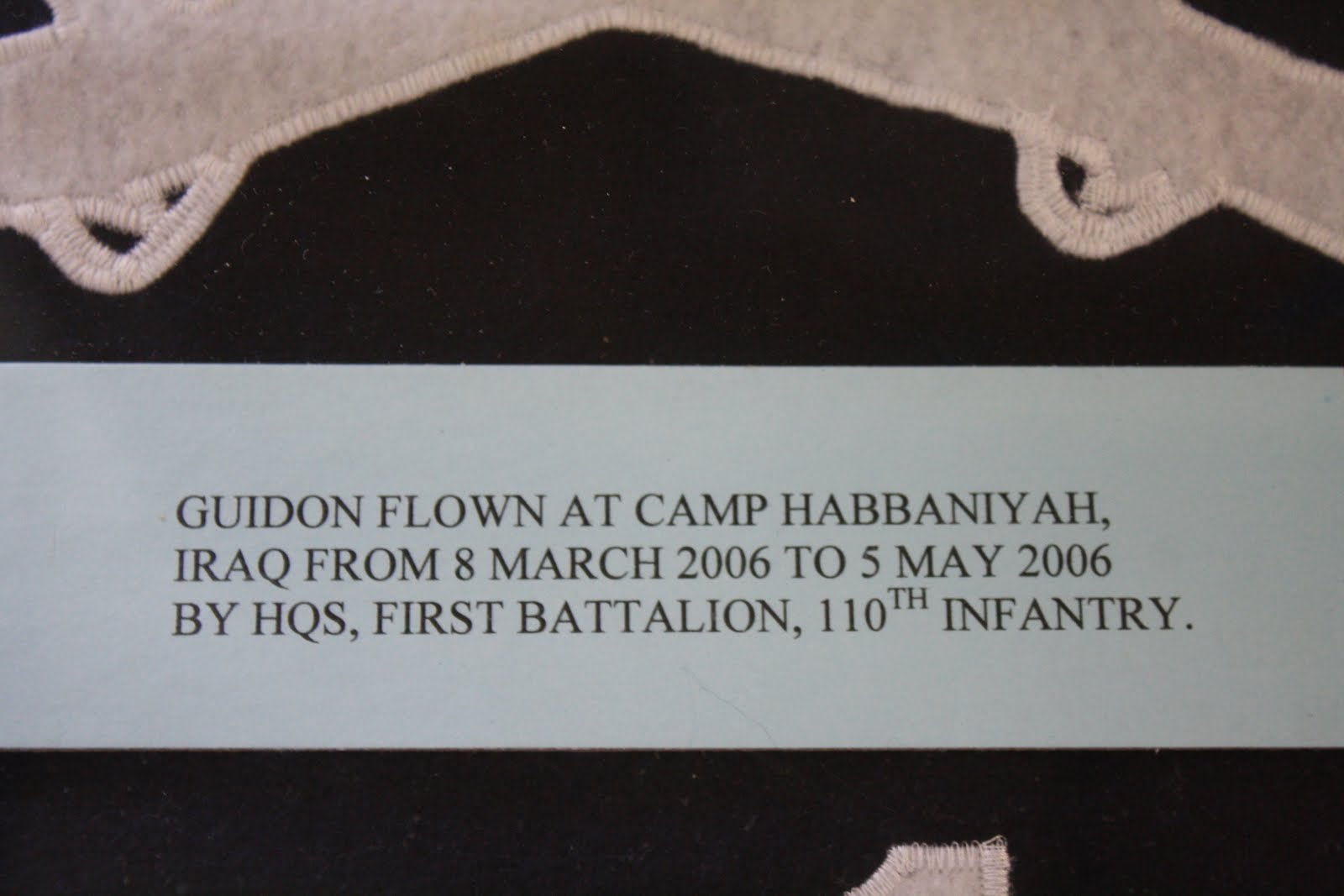
This is a photo of a banner and the photo below explains what this banner is.


This case displays some of the things brought back from Afghanistan by a soldier.


This tank is outside the museum.


The two photos above show and tell of the history of the photo below.


We also saw some displays at the Muir Army Air Field.


This airplane's wing span is so wide that even with my wide angle lens I couldn't get the whole thing in the photo.

The Muir Army Air Field is used for helicopters and we saw lots of helicopters take off, land and fly some flight patterns.


We also saw lots of soldiers -- some on foot, some in land vehicles, and some in the helicopters.


This is A. J. Drexel Biddle Hall, dedicated in honor of General Biddle, whom I mentioned and showed some photos farther above. It was the Red Cross building during World War II.


This is the Murray School which was used from 1850 to 1944.

We also saw a small chapel, which was one of nine chapels in use during World War II.


As you drive in through the entrance of the National Cemetary, you see many, many flags.


There are quite a few Pennsylvania flags and many, many United States flags. There are also large flags, one for each state of the United States.


While we were at the National Cemetery, we spent most of our time there at the Pennsylvania Veteran's Memorial. The photo below shows a stone dedicated to several military people, and there were many of these stones flat in the ground throughout the cemetery.

The Pennsylvania Veteran's Memorial


There are six of these plaques in the Pennsylvania Veteran's Memorial.

There are four fountains in the center of the PA Veteran's Memorial. I took this photo standing nearest the longest of the four. Each of the four was a different size and they were in order from smallest to largest.


These plaques were in a single row all around the tops of the walls inside the PA Veteran's Memorial. There were also plaques like this in the floor on the entrance ramp to the memorial.

Family members place flowers on graves in the grass outside of the memorial.


The boys really enjoyed this field trip, and the little one especially liked all of the helicopters. It was a good and very meaningful field trip. Oh, yeah, and it was FREE. There was a donation jar in the museum but no admission fee.

Wednesday, May 19, 2010

Teaching Boys and Other Children Who Would Rather Make Forts All Day

I love speakers who add a little humor into their presentations. Andrew Pudewa did just that. The title of this post was the title of the seminar that I attended that Mr. Pudewa presented at the CHAP homeschool convention. (He also led another seminar or two). 

The information in this seminar was very interesting. Apparently a man named Dr. Sax did extensive research and has written a couple of books: Boys Adrift and Why Gender Matters. Mr. Pudewa shared some of the information found by Dr. Sax. Boys do not hear as well as girls. They do not process as soft a sounds as girls do. 

Also, because of the optic nerve and retina differences, boys also see differently than girls. Boys and men see speed and direction with more vibrancy while girls and women see color and texture with more vibrancy. 

Mr. Pudewa explained an experiment Dr. Sax performed. He hung a spinning mobile over a crib and had an attractive women sit in a chair near enough the crib for the infants to be able to see. Every boy infant placed in the crib only watched the spinning mobile, while every infant girl placed in the crib only looked at the lady in the chair. 

Mr. Pudewa also talked about the different types of relevancy for learning. There is "intrinsic relevancy" -- something is interesting simply because it just is; "inspired relevancy" -- something may not be particularly interesting to your child but one of the child's friends may really like it so your child becomes interested in it because of the love and respect he/she has for his/her friend; "relevancy of 3rd resort" -- things that are just not interesting to most people; "contrived relevancy" -- making something relevant by teaching through games and fun; and, finally, "enforced relevancy" -- is not and can not be made interesting and the student must do it anyway (this type of thing needs to really be limited). 

Then, Mr. Pudewa explained the 3 Laws of Motivation: 1) Children like to do what they can do; 2) Children want to do what they think they can do; 3) Children hate and will refuse to do anything they think they cannot do. 

He suggested that you do your best to comprise your child's schoolwork with 80% of the first law of motivation, 20% of the second law of motivation and 0% of the 3rd law of motivation. 

Mr. Pudewa suggested saying 10 positive things before giving any corrections; smile at your children often because it says you love them and care about them. Show unconditional love and appreciation. Give them opportunities and encouragement and remember that they learn better from someone who enjoys and is interested in what they are teaching.

Tuesday, May 18, 2010

CHAP Homeschool Convention 2010

I'm sorry that I haven't posted in quite some time. I've been having lost of computer problems.
I wanted to share about our annual CHAP Homeschool Convention that took place Friday and Saturday, May 7th and 8th, 2010 in Harrisburg, PA. I love the convention. I have not missed a single year since we've been homeschooling. Even if I don't have a lot that I need to purchase for the following school year, it is so worth going for the seminars. The speakers are very good, and I can always find something that applies to where I am at in my homeschooling journey. It's great because I always come home refreshed, rejuvenated and excited for the coming school year.

This year there weren't any well-known speakers, other than Michael Smith of HSLDA, but they had lots of great things to share. I wanted to find a good program to teach our new little guy how to read. This year we've been working on some simple 3-letter words, after I was sure he knew the alphabet and the sounds of the letters, and he's been doing really well with that, but I want him to be able to start some actual reading next year. When our middle boy was learning all of this, we used "Sing, Spell, Read and Write" which was wonderful, but I sold it a couple of years ago because we thought we were done adding to our family, and now it's no longer available.

Well, I was able to find another great program. It's called "Rocket Phonics". It was created by a kinesthetic learner and his wife. It's got great activities for kinesthetic learners and active boys and I'm sure our little guy will love it. It even includes some scavenger hunts. I found it by attending a seminar entitled "Hands-On Teaching Tips for Hands-On Learners and More!" I think that our little one is a combination of the kinesthetic learner and the visual learner. He likes to do things for himself, and loves to touch and move things, but he also loves to look at brightly colored pictures and find things in pictures.

In the seminar, Stephen Guffanti said that the kinesthetic learners experience before learning. He said that impulsivity drives hands-on learners to learn faster. He said the philosophy of kinesthetic learners is to "make mistakes, learn from them, make more mistakes and learn more." Stephen said that kinesthetic learners want to know three things: 1) Is it moving?
2) Can I touch it? 3) What happens next?

Stephen Guffanti said that kinesthetic learners think when they move (no movements, no thoughts). He suggested you teach to their strengths, (which I would recommend for every type of learner), not their weaknesses. He said that they need to be doing something else while they are learning. He suggested putting a rubber band around the front two chair legs so that they can bounce their feet on it, if you have them sitting at the table, because this is movement they can do that is relatively quiet and should not disturb others. He also suggested keeping lessons short and taking mini breaks and/or playing games. He suggested that you have them do brain warm-ups before even trying to begin lessons. He suggested cross-body movements (i.e. doing a movement with the right arm and the left leg at the same time, etc.).

If a kinesthetic learner's energy level is too low, they're doing something too frustrating. Let them get up and move or jump, etc. It's best not to make kinesthetic learners sit for lessons, but they can learn while sitting if you use the rubber band as mentioned above or have them sit on a textured chair. They can also learn while playing catch or jumping up and down on a trampoline.

I hope you found this information helpful. I will post again, hopefully tomorrow, about another seminar and speaker that I experienced at the convention. After I finish posting about the convention, I will post about the end of our school year. Our last day is Tuesday, May 25th.

Monday, March 22, 2010

Speech and Debate

Do you think that Speech and Debate is an important thing for students to learn? What ever happened to the Debate clubs of old? Even when I was in public school years ago, there were no debate clubs and competitions.

Well, Speech and Debate is alive and well in homeschooling. My oldest son is interested in Speech and Debate, and earlier this year we saw a notice in our county homeschool magazine about a Speech and Debate club that students could participate in. However, after contacting and speaking with a woman about it, we found that it just wasn't feasible for us to participate in due to the fact that it was a good distance away, and the time that they met each week just didn't work well for us either.

So, we found out about a Speech and Debate tournament that was being held in our area this past Thursday, Friday and Saturday, and we decided to check it out. Now, let me just say that, going into this, I knew a little about speech but nothing about debate. I was so impressed at this tournament. These students obviously put a lot of effort, time, research and hard work into these activities and they reap valuable benefits. They gain a wealth of knowledge as well as some valuable skills such as discernment and wisdom, research skills and critical thinking skills. They gain excellent communication skills.

We heard one young man do a Persuasive Speech on healthcare and I wanted to rush him to the government to speak before they voted on the new Obamacare issue. This young man had convincing facts and options that I felt were intelligent and would work. (Need I say I completely disagree with Obamacare?)

It was obvious to me that these students had a bright, successful future ahead of them, and I got excited about the possibility of my son participating in this. Unfortunately, we still don't have a Speech and Debate near us. So I did what all good homeschooling moms do. I prayed about it and I began to research how to teach it. I contacted a couple of people as well. Well, God has opened doors and shown me how to do this. So, when the 2010-2011 school year begins, I will be leading a Speech and Debate club at our co-op, and I am very excited about it because I have just watched as God has shown me the way. It always amazes me how God gets things done and gives me the courage, confidence, resources, and tools I need to do something when I seek His will.

I will be running a National Christian Forensics Communication Association (NCFCA - formally known as HSLDA debate) affiliated Speech and Debate club. NCFCA is a national organization with Speech and Debate tournaments in every state in the United States. So, if you are interested in learning more, visit their website at http://www.ncfca.org.

I have ordered my resources and eagerly await their arrival so that I can begin to learn about Speech and Debate so that I will be ready to lead a successful club in the 2010-2011 school year.

Monday, March 1, 2010

Applied Engineering

My oldest son is taking an Applied Engineering class at our co-op. Last Wednesday, they had their first project completed and ready for testing. They had to build a bridge out of popsicle sticks and the test was to see how many bricks the bridge could hold before it broke.

This is the group that my son was in. He's the one in the middle, and that's their bridge on the cement blocks.


The teacher began placing bricks upon the bridge, and, sadly, the bridge began to sag a little; but mostly, the one side wanted to give way.

The teacher said that if was going to break, it had to break "down". It didn't count if just a side broke.

So, a mom stepped in to help hold the bricks so that they would continue to build until the middle of the bridge would break, instead of the bricks simply falling off of the side.

Well, it only held eight bricks until the middle did break DOWN. My son was disappointed. He said he didn't really want the sides built the way they were, but when you work as part of a group, you have to compromise and let each person make decisions.

This was the next group and their colorful bridge. This bridge turned out to be quite strong. The teacher had only brought eleven bricks with him and this bridge held all eleven. Then, each of the team members who built the bridge took turns standing on it to see if it would hold them -- it did!

This young man is the tallest in the class and they thought he might also weigh the most, so they had him stand on it, and . . .

He brought the bridge down!


This bridge held all eleven bricks as well. It also held several people, including the teacher, who took turns standing on it. Then . . .

two of the three boys who made it decided to try to stand on it together, and . . .

they brought the bridge down!